.svg)
Why fashion's emissions keep rising — and why overproduction, not efficiency, is the real problem
Fashion's emissions rose nearly 14% in two years despite cleaner production. The real problem is overproduction.
📌 Key takeaways
We really don't want to be all doom and gloom here — promise. There's actually a name for what happens when people see the same alarming headline one too many times: psychologists call it psychic numbing (you might know it as climate fatigue). We see it, we sigh, we scroll. But some news you don't get to scroll past, and this is one of them: the UN made it official — the world will overshoot 1.5°C of global warming. The number 195 countries signed in Paris, the number printed on a decade of pledges, keynotes, and sustainability reports — gone. Not "at risk." Not "hanging by a thread." Dead, by the UN's own assessment.
Read that again. 1.5°C was never an arbitrary target. It was the boundary scientists drew between damage we can adapt to and damage we can't undo. Coral reefs. Ice sheets. The number of hours a garment worker in Dhaka can safely spend on a factory floor in summer. That is what the world just overshot.
And in the same news cycle, fashion; an industry that spent that exact decade making climate commitments, reported that its emissions went up.
According to the Apparel Impact Institute's latest Taking Stock report, fashion's emissions rose 6.3% from 2023 to 2024 — the second consecutive year they moved in the wrong direction. Bloomberg puts the two-year increase at nearly 14%.
That number deserves a second look, because it's easy to read past. This is not the story of an industry that failed to try. Over that same period, brands published sustainability reports, signed pledges, launched takeback programs, and invested in preferred materials. Production genuinely became less carbon-intensive per unit. Aii's own analysis says so.
And emissions still went up 14%.
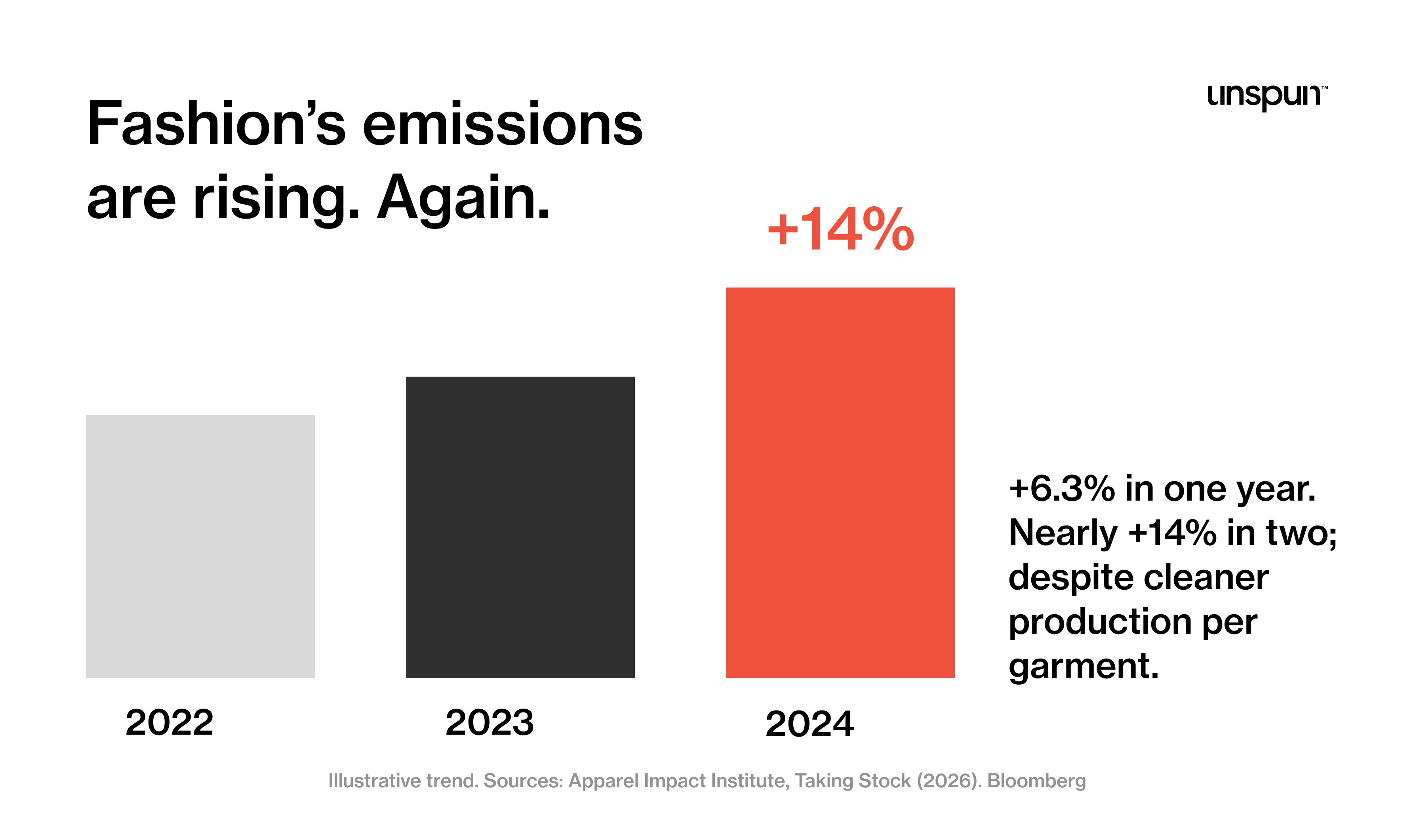
Here's the mechanism, and it's brutally simple: efficiency gains per garment are being outpaced by the number of garments. Fiber use keeps growing — especially polyester — and every intensity improvement gets swallowed by volume. You can make each unit 5% cleaner, but if you make 10% more units, the atmosphere doesn't care about your per-unit math.
This is the industry's uncomfortable core truth: fashion doesn't have an efficiency problem, it has an overproduction problem. Somewhere between 10 and 30% of what gets made is never sold at full price — much of it never sold at all. In the year the UN pronounced 1.5°C dead, the industry is still burning carbon to manufacture clothes whose most likely destination is a markdown rack, a landfill, or an incinerator. Supply chains require brands to guess demand 9–12 months out, place enormous bets in faraway factories, and then manage the misses. The waste isn't a bug in this system. It's the operating model.
Aii's takeaway is that the industry needs to move from climate commitments to factory-level projects — renewable energy, efficiency upgrades, electrification — with brands and financiers helping suppliers pay for it. We agree, and we'd add: those projects are necessary but not sufficient. Decarbonizing the manufacturing of goods nobody needed was never the plan.
If overproduction is the disease, circularity is the treatment the industry has rallied around. So how's it going?
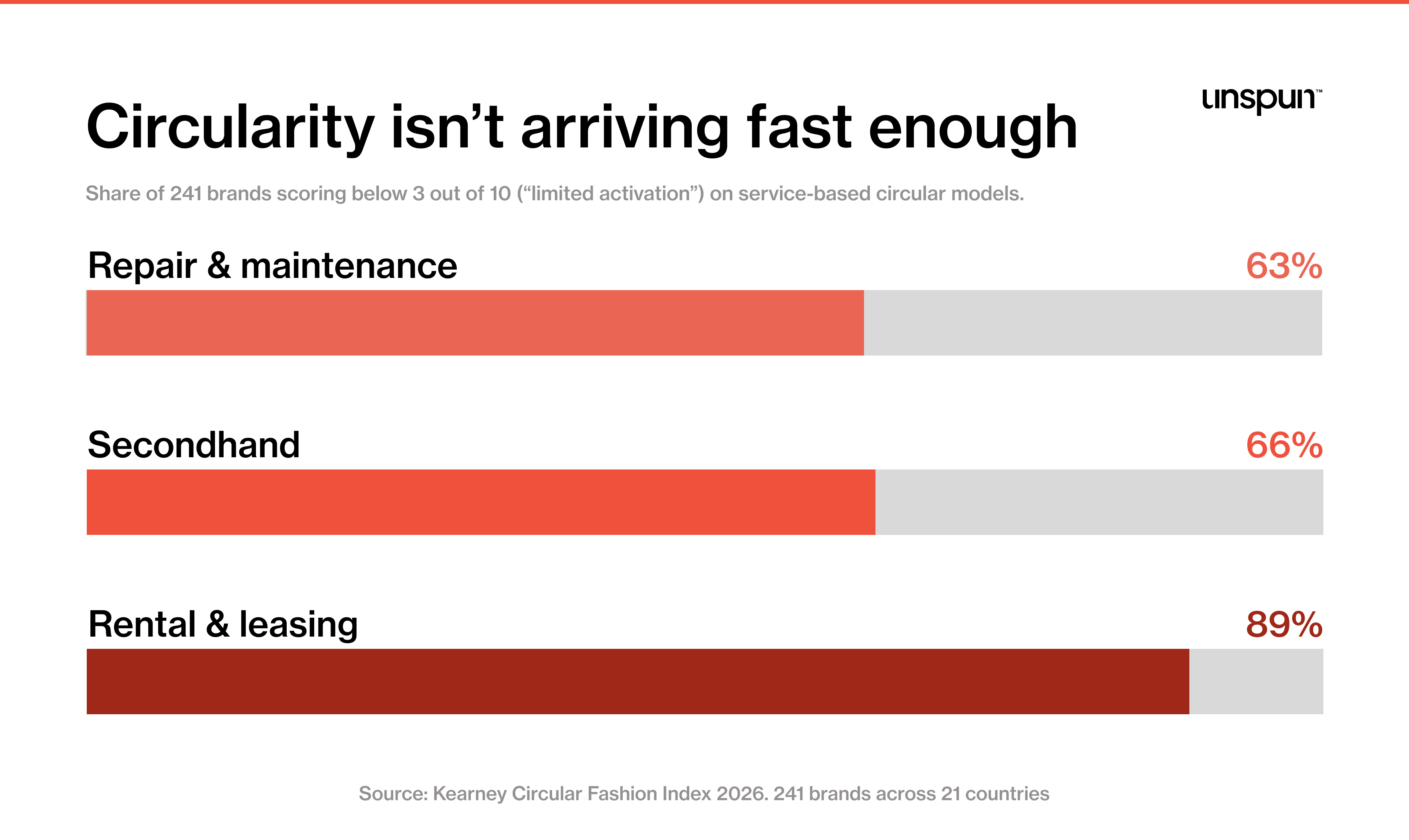
Kearney's Circular Fashion Index 2026 — now in its sixth edition, assessing 241 brands across 21 countries — gives us an honest answer. Regulation is raising the floor: product data, material commitments, and post-use systems are becoming a condition of market access, particularly in the EU. That's genuinely good.
But look at the operational reality. Per Kearney, 63% of brands score below 3 out of 10 — "limited activation" — for repair and maintenance services. 66% score below 3 for secondhand. For rental and leasing, it's 89%. The service-based circular models that would actually extend a garment's life remain, in Kearney's words, far from mainstream. Expanding them depends on consumer demand, viable economics, and the ability to run services at scale — three things that don't materialize just because a regulation says they should.
There's a deeper point buried in the report that we think matters more than any single score: compliance doesn't create a return by itself. A brand can build the reusable product record, publish the material data, stand up the takeback bin — and still be producing the same volumes on the same 9-month guess. The advantage, Kearney argues, comes from improving economics across the entire product lifecycle: lower excess and markdowns before sale, retained value after it, better recovery at end of life.
Read that carefully and you notice something. The single biggest lever on that list isn't post-use at all. It's lower excess. It's the stuff you never made.
This is where we'll say the quiet part: circularity, as currently practiced, is mostly downstream. Takeback, resale, recycling — these are systems for managing products after the overproduction has already happened. They matter. We support them. But they operate on the output of a machine that is fundamentally calibrated to make too much.
The upstream question is harder and more interesting: why don't we just make less, better, and only when it's needed?
Make goods designed to last. Make them close to the customer. Make them when demand is real rather than forecast. If the industry did only this — no new takeback infrastructure, no rental apps — emissions would fall, because the 10–30% of production that exists purely to be marked down or destroyed would simply never be woven.
That's not a thought experiment. In a world that has already overshot 1.5°C, it's the only question left that matters.
unspun is a fashion technology company building OneWeave™, the world's first 3D weaving technology for apparel. Instead of weaving flat fabric that gets cut into panels and sewn back together, OneWeave™ weaves yarn directly into three-dimensional garment form — eliminating most of the cut-and-sew waste stream and the panel-cutting losses that come with it. Because the machines are automated, production can happen close to demand, on-demand, at the moment an order exists. No season-ahead gamble. No container ships full of maybes. In our factory, yarn becomes a finished garment in minutes, not months.
We won't pretend this is a solved problem at industry scale — it isn't, and anyone who tells you their technology single-handedly fixes fashion is selling something. Scaling on-demand manufacturing means proving reliability shift after shift, meter after meter, with real manufacturing partners and real brands. That's the unglamorous work we spend most of our time on.
But here's why this year's numbers made us more convinced, not less:
In a searing essay marking ten years of We Don't Have Time, founder Ingmar Rentzhog argues that the biggest lie ever told is only four words long: "we have more time." Not the loud denial of extremists — the calm, respectable version spoken in parliaments and boardrooms, the one that accepts the science and schedules the solution for a decade that keeps moving. And he warns that its successor is already being normalized: "it's too late, so nothing matters." Both lies lead to the same place — business as usual, for decades more. The truth, he writes, sits between them: too late to avoid all the damage, absolutely not too late to decide how big it gets. Every tenth of a degree still matters. Delay kills; speed saves.
That's exactly where we land on fashion. The death of the 1.5°C target is not permission to stop, and it is not proof that trying was pointless. It's the end of the era where commitments counted as progress. What counts now is physics: tons produced, tons avoided, tons emitted.
Fashion's next decade will be decided upstream — in how garments get made, where, and in what quantity — not in the recycling bin. The industry doesn't need another pledge. It needs factory-level change, financed properly, deployed at manufacturing scale. That means electrifying and decarbonizing existing production, as Aii argues. And it means building the new production model in parallel: one where a garment begins its life because someone wanted it, not because a spreadsheet twelve months ago guessed someone might.
We started unspun because we believed the industry's inventory model was broken. Two years of rising emissions, a dead climate target, and 241 brands' worth of circularity scores later, we no longer think of that as a belief. It's just what the data says.
The math stopped working. What replaces it — making only what's needed, where it's needed, when it's needed — is more important than ever.
Fashion's emissions rose 6.3% from 2023 to 2024 — the second consecutive annual increase, and nearly 14% over two years — because growth in production volume, especially polyester fiber use, outpaced per-garment efficiency gains, according to the Apparel Impact Institute's Taking Stock report.
Overproduction is the industry practice of making more garments than people buy. Brands forecast demand 9–12 months ahead and produce in bulk, and an estimated 10–30% of garments are never sold at full price — many are marked down, landfilled, or incinerated. It is the structural driver of fashion's waste and rising emissions.
Not on its own. Takeback, resale, and recycling manage products after overproduction has already happened. Kearney's Circular Fashion Index 2026 (241 brands, 21 countries) shows service-based circular models remain marginal, and identifies lower excess production as the biggest economic and environmental lever.
3D weaving is a manufacturing process that weaves yarn directly into a three-dimensional garment form, skipping flat fabric production, most panel cutting, and most sewing. unspun's OneWeave™ is the first 3D weaving technology purpose-built for apparel, producing a finished garment from yarn in minutes.
On-demand manufacturing produces a garment only after real demand exists — an actual order — rather than against a season-ahead forecast. Combined with localized, automated production, it eliminates deadstock, cuts inventory risk and markdowns, and removes the emissions of making clothes nobody buys.
Sources: Apparel Impact Institute, Taking Stock · Bloomberg · Kearney Circular Fashion Index 2026 · We Don't Have Time on the UN 1.5°C report · Ingmar Rentzhog, "The Biggest Lie Ever Told Is Only Four Words Long," We Don't Have Time
