.svg)
You can't recycle your way out of a destruction ban
The EU just banned destroying unsold clothes. Recycling and resale won't be enough to comply. The real fix is producing only what will actually sell.
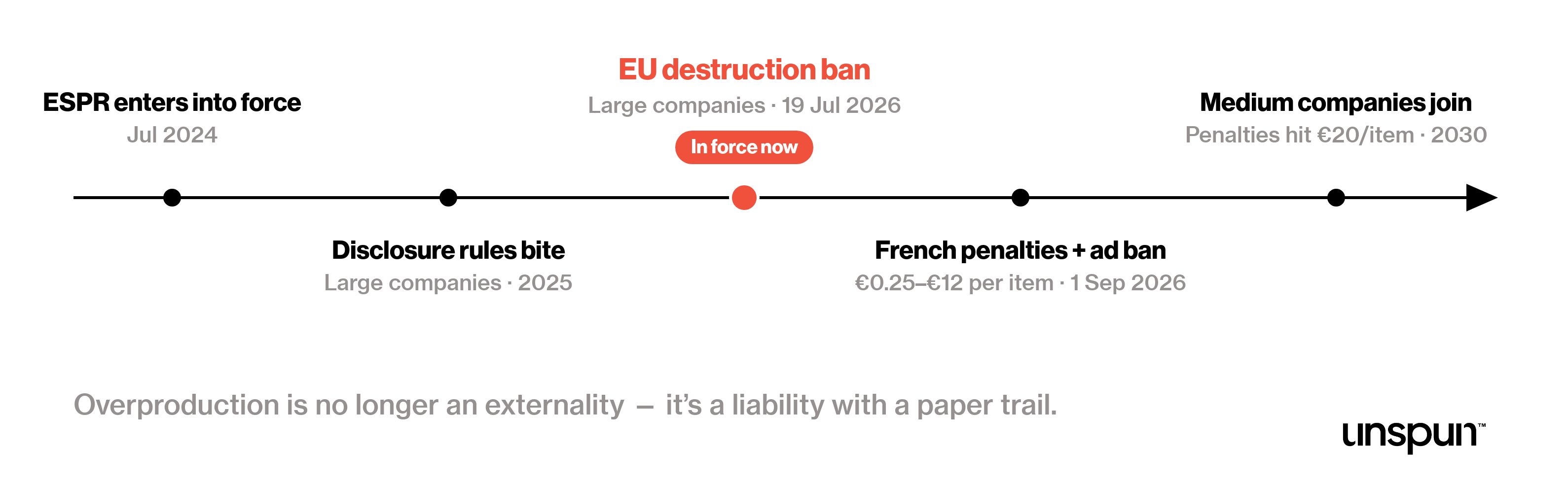
On July 19, it became illegal for large companies to destroy unsold clothing, accessories, and footwear in the EU. Not frowned upon. Not "disclosed in the sustainability report." Illegal. Brands are now expected to sell, donate, or prepare unsold goods for reuse, with medium-sized companies joining in 2030.
France went even further this summer: from September, ultra-fast fashion items sold there carry an environmental penalty of up to €12 apiece (rising to €20 by 2030), plus an advertising ban that covers influencers. A pair of fast-fashion jeans will carry a €9 surcharge this year.
We think this is good news. We also think most of the industry is about to respond to it the wrong way.
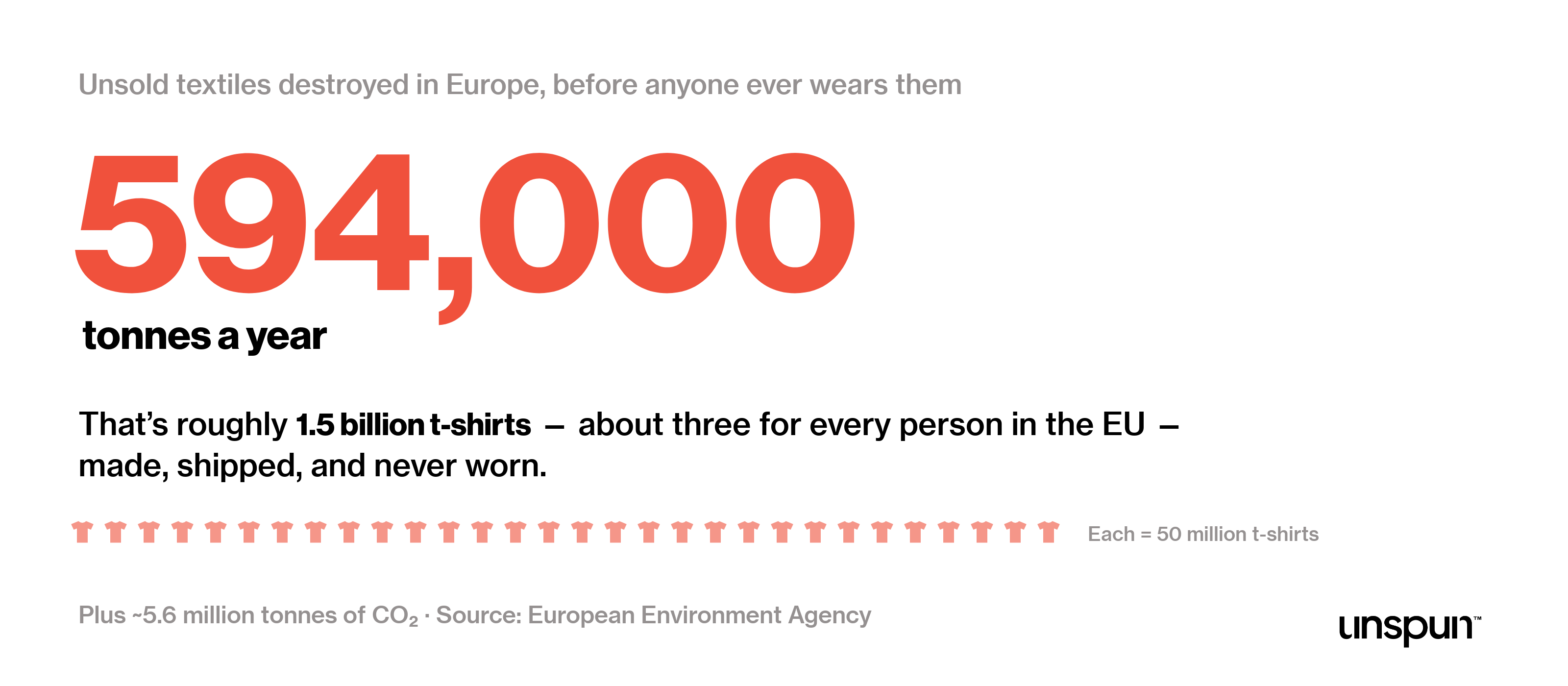
Here's the scale of the thing: 4–9% of textiles put on the European market are destroyed before anyone ever wears them. Up to ~594,000 tonnes a year, and about 5.6 million tonnes of CO₂.
Destruction is only allowed under narrow derogations, every exemption has to be disclosed, and the documentation has to be kept for five years. Pair that with the disclosure rules already in force and the digital product passport on the horizon, and the direction is unmistakable: unsold inventory is about to become the most visible number in fashion.
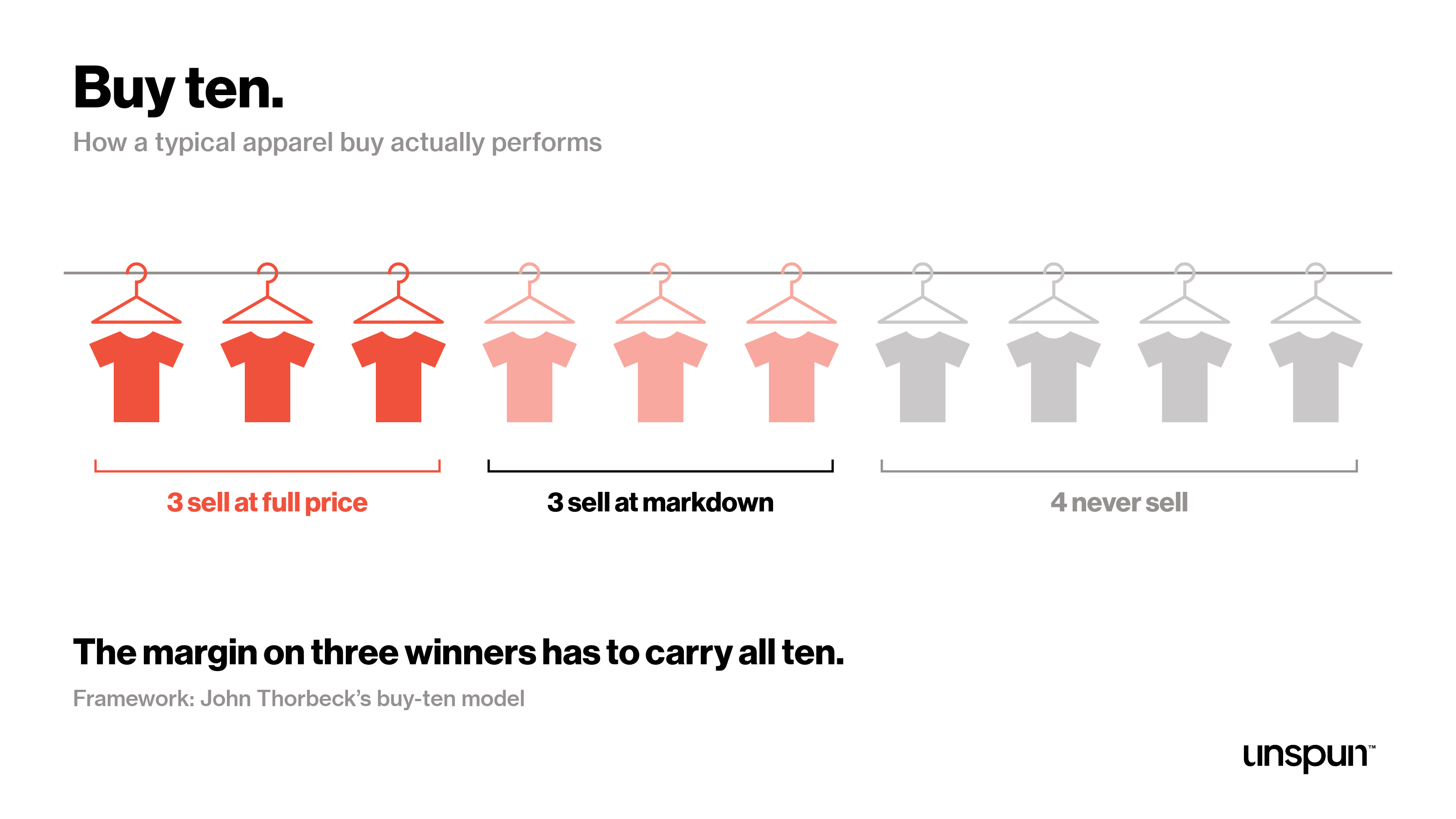
Why does so much brand-new clothing exist with nowhere to go? Trace it back and it's not a merchandising mistake, it's a timing problem. A brand has to commit to fabric, cut, and quantity six to twelve months before it has any real read on what customers will want. Some of that bet lands. A lot of it doesn't. John Thorbeck's buy-ten framework puts a number on the gap: of ten units produced, three sell at full price, three sell at a markdown, and four never sell at all. Destruction was never the disease, it was just the cheapest way to hide the symptom.
Follow the incentives further and the pattern makes more sense. Factories running on thin margins need volume and long lead times to hit a workable unit cost, so brands over-order to get the price down, then have to guess, months out, exactly which colors and sizes will move.
Understocking is the same failure from the other direction. When Lululemon told investors in 2024 that it left revenue on the table by not having enough of the right colors and sizes, that wasn't a forecasting near miss, it was proof the model can't flex either way. A warehouse of unsold goods and an empty shelf look like opposite problems. They're the same problem: a decision locked in long before the demand exists to inform it.
The official guidance says: resell, donate, prepare for reuse. All good things. All downstream.
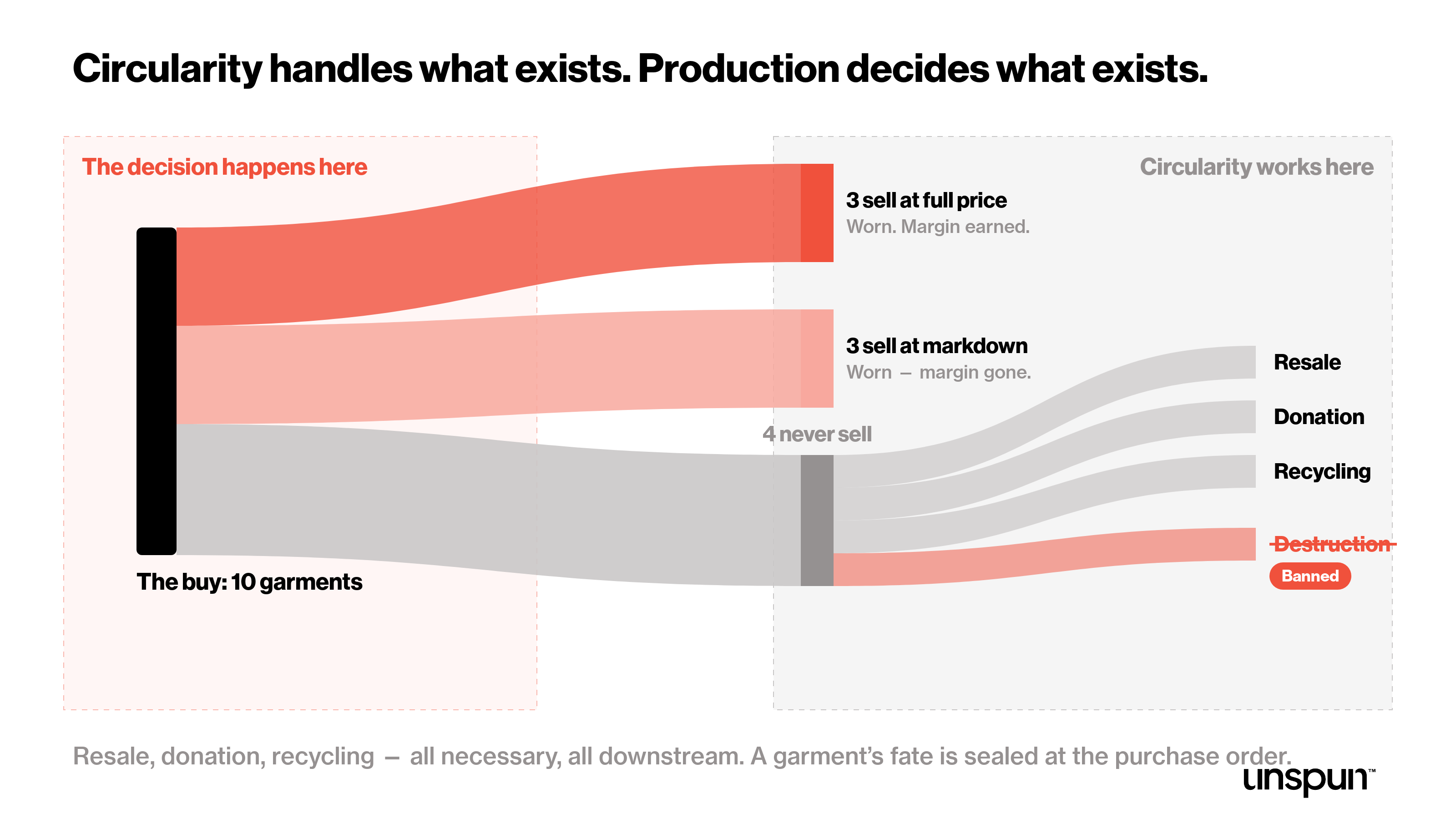
Every unsold garment that gets rerouted into resale or donation still cost the full price to make: the fiber, the dye, the freight, the emissions. Fashion is responsible for up to 4% of global emissions and is on track to miss its 2030 reduction targets by half. Reselling or donating it doesn't undo that cost, it just finds a second home for something that shouldn't have been made in the first place. And recycling, however necessary, still only captures a sliver of textile waste.
And the stakes aren't abstract. The industry's 90+ million workers are on the front line of the climate impact it creates: key apparel production hubs have seen dangerously hot days rise by more than 10% over two decades, and in Bangladesh in 2024, one in five garment workers took sick leave during the hottest months.
There's a reason "reduce" comes first in reduce, reuse, recycle. Circularity handles what exists. Only production decides what exists.
A new white paper from Because Capital, Unlocking Trapped Value, puts numbers on what happens when brands stop committing to finished goods before demand is known and start committing to raw materials and capacity instead. In Project Interlace's modeling, moving just 10% of the buy to responsive, onshore production took modeled retailer margin from 9% to 23% of retail price, cut markdown and liquidation costs by ~67%, and, for core products, cut inventory by ~70% while service levels rose from 85% to 98%.
This isn't just a model, and it isn't new.
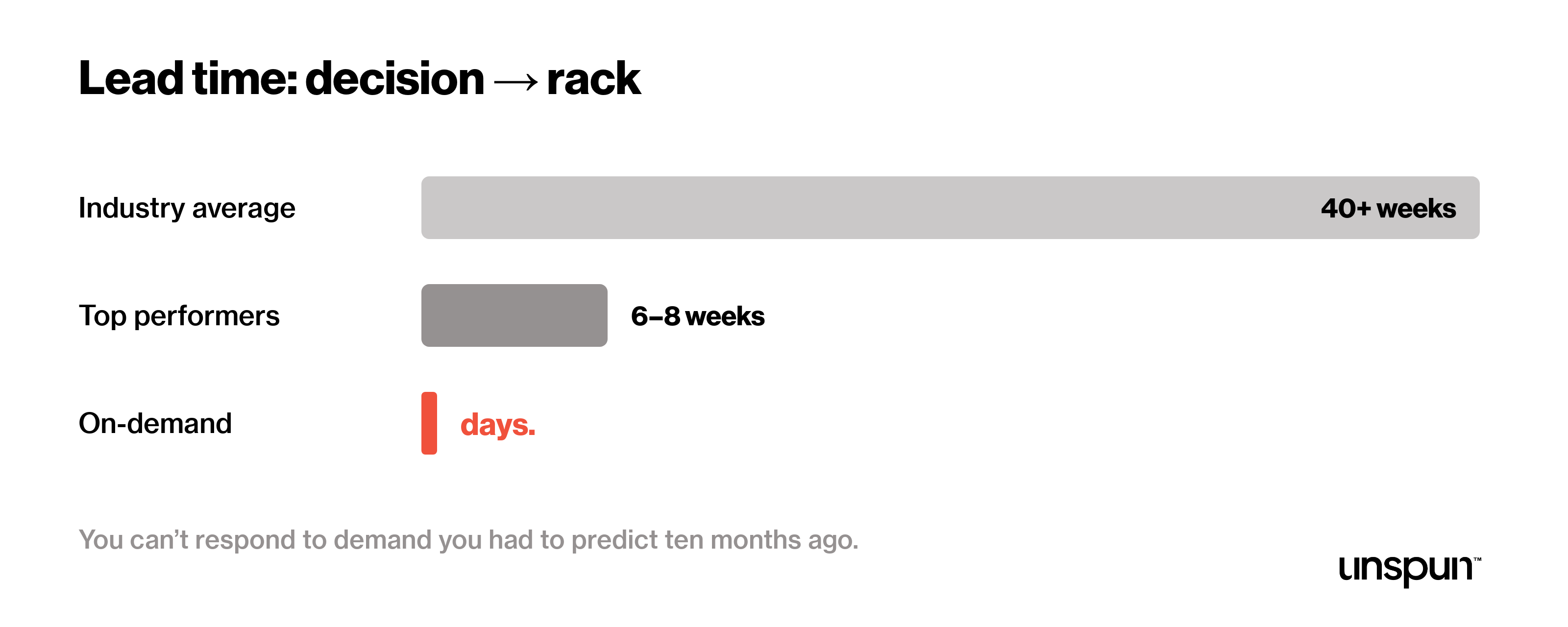
So why hasn't the industry moved? Because this is a business-model problem, not a technology problem. The speed exists: top performers get products to market in six to eight weeks while the industry average sits at forty-plus. But inside most brands, the team scored on first cost gets rewarded for the big, cheap production run while another team quietly absorbs the inventory risk it creates. Responsive pilots get built outside core systems, succeed, and then die the moment scaling them means confronting the operating model itself. That only changes when it's driven from the top.
The pattern across forty years of evidence: less waste and more money. This is why sustainability is quietly migrating from the CEO's keynote to the CFO's spreadsheet: Global Fashion Agenda put CFOs at the center of this year's Global Fashion Summit, because compliance, markdowns, and trapped working capital are now P&L line items, not PR ones.
The cleanest way to comply with a destruction ban is to have nothing to destroy.
To be clear: nobody's arguing every garment should be made on demand. The emerging model is hybrid: bulk production for what you can confidently forecast, responsive production for what you can't. The mix is the strategy.
The brands that come out of this decade ahead won't be the ones with the best liquidation strategy, they'll be the ones that stopped needing one.
This is the problem unspun exists for. Our OneWeave™ system weaves yarn directly into garment shapes — on demand, close to the customer, with almost zero waste. No minimums that force brands to over-order. No warehouse of finished goods waiting to become someone's compliance problem. Production that starts when demand shows up, not eighteen months before.
Regulators have decided overproduction's free ride is over. Circularity will catch what's already in the system. But the brands that come out of this decade ahead won't be the ones with the best liquidation strategy, they'll be the ones that stopped needing one.
